
Picking the right car seat for your child is an important choice for any parent. It’s about more than just comfort—it’s also about keeping your child safe and giving you peace of mind every time you drive. Before you decide, take some time to learn about the benefits of baby car seats and the different types available so you can find the best fit for your child.
Why Do You Need A Baby Car Seat?

Whether you’re heading out on a family road trip or just making a quick run to the store, the right child car seat keeps your baby snug, secure, and protected from sudden stops or unexpected bumps. With the right seat, you can focus on driving and worry less about your child’s safety.
Baby car seats protect infants and children in accidents and greatly reduce the risk of injury. According to the National Highway Traffic Safety Administration (NHTSA), using car seats lowers the chance of fatal injury in passenger cars by 71% for infants under one year old and by 54% for children aged one to four, compared to unrestrained children. In light trucks, the risk of fatal injury drops by 58% for infants and 59% for children when using car seats. Before you choose, it’s important to learn about the different types of car seats so you can pick the best one for your child.
What Are The Different Types Of Car Seats For Children?
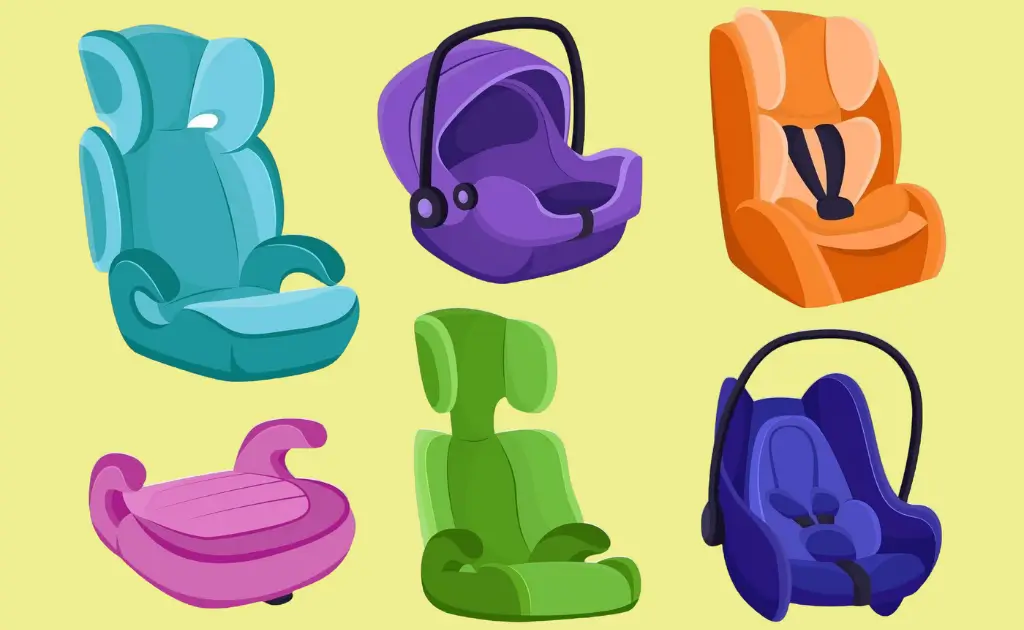
There are five types of baby car seats: infant, convertible, all-in-one, booster, and combination. Each type supports a specific stage of your child’s growth and provides unique benefits.
Let us explore each car seat one by one.
1. Infant Car Seats

Infant car seats are the best option for parents searching for a car seat for their newborns and infants. These car seats keep your child safe in a crash by providing strong protection. They are rear-facing, meaning they face the back of the car. This design helps protect your baby’s head, neck, and spine in case of a sudden stop or collision.
Imagine you’re carrying a precious, fragile egg. You would want to cushion and protect it as much as possible. That’s what an infant car seat does for your baby.
Ideal Age and Weight Range
Age: Most parents use infant car seats from birth until their baby is about 1 year old..
Weight: An infant car seat can hold children from 4 pounds to 22-35 pounds, depending on the car seat model.
They are perfect for the first few months when your baby needs the most support and protection. If your baby weighs 7 pounds, they might use the infant car seat comfortably for the entire first year.
Pros and Cons
Pros
- Portability: Infant car seats are small and portable. These seats often attach with a detachable base, making it easy to move your baby from the car to the stroller or home without waking them.
- Safety: Manufacturers design these seats to provide maximum protection for newborns, featuring side-impact protection and a five-point harness.
- Convenience: You can attach many infant car seats to compatible strollers, which creates a seamless travel system.
Cons
- Shorter Lifespan: When a child reaches the weight or height limit for their car seat, parents need to buy a new one, which can be expensive. Since children grow quickly in their first year, most outgrow their car seat fast. This means parents often have to switch to a convertible or a different type of car seat within about a year.
- Additional expense: When your baby outgrows the current car seat’s weight or height limit, you’ll need to buy a new one, which can increase your costs.
Explore our expert picks in the 5 Best Infant Car Seats in 2025 — a must-read for new parents!
2. Convertible Car Seats

It’s time to switch to a convertible car seat for your child once they outgrow their infant seat. These seats provide long-term car safety since they fit your child from infancy through the toddler years and beyond.
Ideal Age And Weight Range
Convertible car seats adjust to your child’s growth and needs.. They provide two directions for your child to use as he grows.
- Rear-Facing: You should keep your child facing backwards for as long as possible, ideally until they are two years old or older. This mode is suitable for infants up to forty pounds.
- Forward-Facing: Move your youngster to a forward-facing seat as soon as he turns 2. By that time, they are ready for a booster seat, and always use the harness system. Ideal for kids weighing 20-65 pounds.
Pros and Cons
Pros
- Dual Modes: You can use convertible car seats in rear-facing mode for infants and switch to forward-facing mode for toddlers.
- Adjustable Harness: Many models of convertible car seats attach to an adjustable harness and multiple recline positions to accommodate your growing child.
- Higher Weight Limits: Convertible car seats typically support higher weight limits than infant car seats, allowing for extended use.
- Versatile and Cost-Effective: You can use convertible car seats from infancy through toddlerhood, switching from rear-facing to forward-facing positions to maximize your investment.
Cons
- Unportable: You cannot easily move convertible car seats or use them as baby carriers.
- Bulky: As convertible car seats are heavier and larger than infant car seats, many people prefer infant car seats for newborn babies.
- Fixed: Once installed in a vehicle, convertible car seats are not easily removable because they lack a base.
How long should a baby be in a rear-facing car seat?
Experts recommend keeping your baby in a rear-facing car seat until your child reaches the manufacturer’s maximum height or weight limit, usually around age 2 or older.
3. Booster Car Seats

As children grow, booster seats are essential for their safety during journeys. These seats bridge the gap between harnessed car seats and the vehicle’s seat belt, subsequently providing a safer fit for older children.
Types of Booster Car Seats
There are two types of booster car seats.
- High-Back
- Description: These boosters have a backrest, which provides head and neck support. They’re ideal for cars without headrests or high seatbacks.
- Suitable For: Younger children transitioning from a harnessed seat, providing extra support and positioning.
- Backless
- Description: These boosters have cushions that raise your child, ensuring the seat belt fits correctly across their chest and hips.
- Ideal For: Older children who don’t need the extra support of a high-back booster but still need a boost so the seat belt fits properly.
Ideal Age And Weight Range
Age: Booster seats provide a safe seating option for most children ages 4 to 12.
Weight: Most booster seats accommodate children weighing between 40 and 100 pounds.
Height: Generally suitable for children up to 4 feet 9 inches tall.
For instance, if your child is 6 years old, weighs 50 pounds, and is 3’6″ tall, they will likely benefit from a high-back booster seat for additional support.
Pros and Cons
Pros
- Better Belt-Fitting: A booster car seat can help raise a child’s body, so the seat belt fits perfectly around it.
- Best Option: A booster car seat is the best choice for children who are too big for a forward-facing car seat and too small for a seat belt.
Cons
- Weight limit: Most booster car seats may not fit a child weighing more than 40 pounds.
- Tight Head Support: Some booster car seats may have tight head support.
It is advisable to take a test ride with your child before purchasing a car seat for him.
Guidance For Preemies or Children with Disabilities:
- Specialized booster seats give your child extra support and safety compared to regular seats.
- Consult with a pediatrician or a certified child passenger safety technician (CPST) for recommendations tailored to your child’s needs.
For children with Medical Complexity, a booster seat with added padding or harness options might be necessary to ensure comfort and safety.
4. All-in-One Car Seats Or 3-In-1 Car Seat

All-in-one car seats are designed to be the only car seat you’ll ever need. They can convert from rear-facing for infants to forward-facing for toddlers and finally to a booster seat for older children.
All-in-one car seats offer a long-term solution for your child’s car safety needs. These seats are designed to transition from infancy through the toddler years into the booster seat phase. Consequently, adapt to your child’s growth to provide convenience and cost savings.
Ideal Age And Weight Range
Age: You can use an all-in-one car seat from birth until your child turns 12 years old.
Weight: An all-in-one seat can carry children weighing between 4 and 100 pounds.
Pros and Cons
Pros:
- Multi-Stage Use: An all-in-one car seat can work as a rear-facing, forward-facing, or booster seat.
- Extended Use: You can typically use an all-in-one from birth until your child is ready to use the vehicle’s seat belt independently.
- Adjustable Components: Its features include adjustable headrests and harness systems to accommodate growth.
- Cost-Effective: An all-in-one car seat is one for all stages, and you don’t need to buy multiple car seats as your child grows.
- Convenience: An all-in-one car seat eliminates the need to switch seats as your child progresses through developmental stages.
- Safety: These car seats provide consistent safety standards through all stages.
- Versatility: You can adapt all-in-one car seats to a child’s needs as they grow, which makes them more versatile than other car seats.
Cons:
- Size: These seats can be bulky, making them difficult to fit in smaller vehicles.
- Installation Complexity: Due to their multiple configurations, they can be more challenging to install correctly.
- Wear and Tear: Long-term use may lead to wear and tear, requiring careful maintenance.
5. Combination Car Seats

Combination car seats are versatile and among the most economical choices for parents who want a car seat that can grow with their children. These seats can transition from a forward-facing harness seat to a booster seat, making them a long-lasting solution for your child’s car safety needs.
Age and Weight Range
Combination car seats provide two modes :
Harness Mode:
- Suitable for children who have outgrown their infant or convertible car seats.
- Generally, these seats suit children aged 2 and older who weigh between 22 and 65 pounds.
Booster Mode:
- This mode suits older children who no longer need the harness but still require a booster to ensure the seat belt fits correctly.
- Typically used for children weighing 40-100 pounds.
Example: A 3-year-old weighing 30 pounds can use the seat with the harness, while an 8-year-old weighing 70 pounds can use it in booster mode.
Pros And Cons
Pros
- Versatility: You can use combination car seats as forward-facing harness seats and then transform them into booster car seats, making them versatile.
- Greater Age and Weight Range: They often support children from around 22 to 65 pounds in harness mode and up to 100 pounds in booster mode.
- Cost-Effective: As these seats transition through multiple stages, they offer good value for money.
- Greater Value: Investing in a combination seat can eliminate the need for separate harness and booster seats.
Cons
Large Size: Combination Car Seats are typically bigger and heavier than other car seats. Therefore, it is hard to transport them from one place to another.
No Handles: Because these car seats lack handles, they can be difficult to carry.
How To Choose A Child Car Seat
By understanding and following the guidelines, you can select the best car seat for your child based on age, weight, height, and other specific requirements. Remember, your baby’s first step toward a secure, comfortable travel experience is choosing the right safety car seat.
The following table compares key features of different types of baby car seats to help you make an informed decision.
Comparison Table
| Baby Car Seat Type | Modes or Types Of Seat | Child’s Age | Child’s Weight | Child’s Height | Benefits | Drawbacks |
|---|---|---|---|---|---|---|
| Infant Car Seat | Rear-Facing | Between 0-1 year | Between 4-35 lbs | Maximum 30-32 inches | 1. Portable with a detachable base. 2. Maximum safety for new born babies. 3. Convenient for a Travel system. | 1. Short Lifespan with child growth. 2. Additional expense due to switching to another type of car seat. |
| Convertible Car Seat | Rear-Facing | Between 0-2 years | Between 4-40 lbs | Maximum 49 inches | 1. Dual Modes 2. Adjustable harness 3. Higher weight limits 4. Versatile 5. Cost-Efficient | 1. Unportable 2. Bulky 3. Fixed |
| Forward Spacing | Between 2 -5 years | Between 20-65 lbs | ||||
| Booster Car Seat | High-Back Booster Seats | Between 4-12 years | Between 40-100 lbs | Maximum 4 feet 9 inches | 1. Better Belt Fitting 2. Best for healthy children | 1. Weight Limit 2. Head Support may be tight in some cases |
| Backless Booster Seats | ||||||
| All-In-One Car Seat | Rear-Facing | Between 0-12 years | Between 4-100 lbs | Maximum 4 feet 9 inches | 1. Multi-Stage Use 2. ExtendedUse 3. Adjustable Components 4. Cost-Effective 5. Convenience 6. Safety 7. Versatility | 1. Bulky in size 2. Installation may be complex |
| Forward-Facing | ||||||
| Booster | ||||||
| Combination Car Seat | Harness mode | Between 2-5 years | Between 22-65 lbs | Maximum 4 feet 9 inches | 1. Versatility 2. Greater Weight and Age Range 3. Cost- Effective 4. Greater Value | 1. Larger Size 2. No Handles |
| Booster mode | Between 5-12 years | Between 40-100 lbs |
Want help picking the best car seat for your child? Explore our expert guide 👇
Frequently Asked Questions
What are the main types of baby car seats?
There are five types of baby car seats: infant car seats, convertible car seats, all-in-one car seats, booster seats, and combination seats. Each type is designed for specific age groups, weight ranges, and developmental stages.
Which type of baby car seat is best for a newborn?
Infant car seats are the best choice for newborns. They provide proper support for a baby’s head and neck and are usually rear-facing to maximise safety.
When should I switch from an infant to a convertible car seat?
You should transition your child from an infant car seat to a convertible car seat once they outgrow the weight or height limits of their infant car seat, typically between 9 and 12 months.
What is the safest position for installing a baby car seat?
The safest position for a baby car seat is the back seat, preferably in the middle, away from airbags, with a rear-facing setup for as long as possible.
How do I know if a car seat meets safety standards?
Look for labels indicating compliance with federal safety standards and certifications. In the U.S., car seats should meet FMVSS 213 (Federal Motor Vehicle Safety Standard).
What’s the difference between an all-in-one car seat and a convertible car seat?
All-in-one car seats are designed to grow with your child, transitioning from rear-facing to forward-facing to a booster seat. Convertible car seats only transition from rear-facing to forward-facing.
What are the four stages of car seats?
The four stages of car seats correspond to a child’s growth and developmental needs:
- Forward-Facing: For toddlers (2–7 years). Uses a 5-point harness and offers extra support. Convertible seats can switch to this mode.
- Booster Seat: For kids (4–12 years). Raise your child so the seatbelt fits properly. Includes high-back and backless types.
- Seatbelt: For older kids and teens (8–12 years). Use when the seatbelt fits correctly without a booster. Follow safety guidelines as your child grows.
Key Takeaways
Baby car seats are essential for ensuring the child’s safety and comfort during travel. First, a baby car seat protects your child from any injury while driving on the road. Secondly, like a mother’s lap, it keeps your baby safe and comfortable. By understanding the features, installation, and age guidelines for different types of baby car seats, you can ensure your child’s safety and comfort as they grow. When making a purchase decision, select a safety seat that fits your child’s age, weight, and height, and consider the car’s specifications.