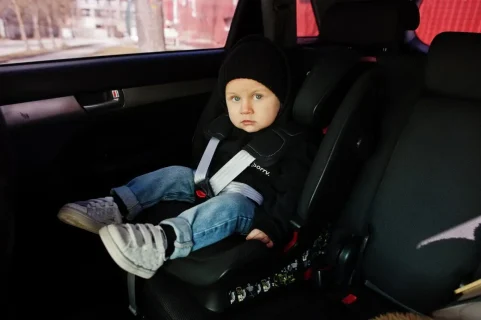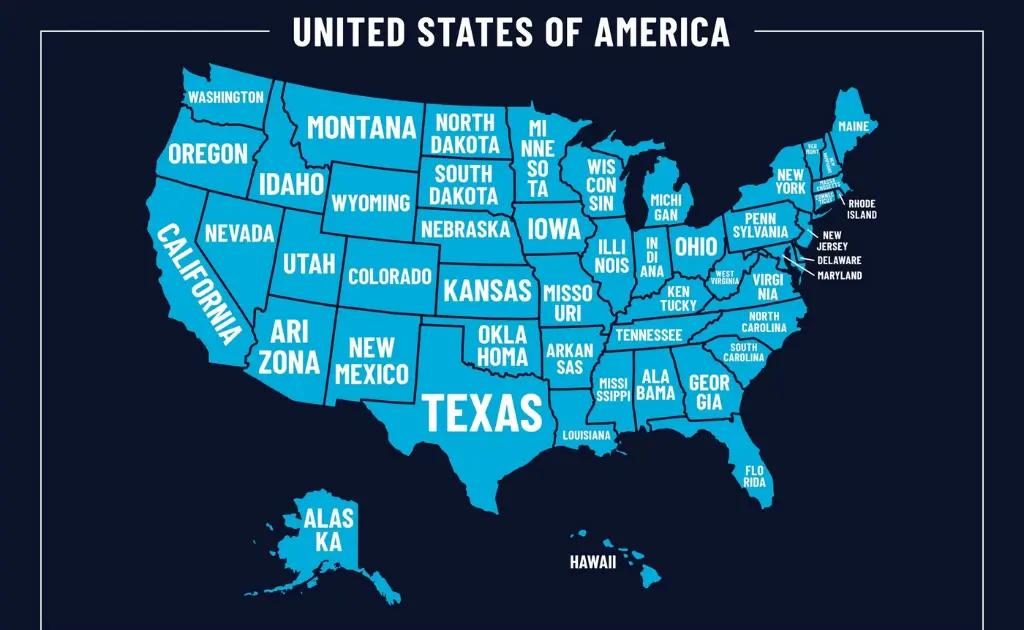
United States map showing all 50 states to explore state-specific car seat laws
Learn about the most up-to-date baby car seat laws in your state.

Baby Car Seat Laws In The USA (2025): State-By-State Guide

Baby car seat laws in the U.S. vary by state because traffic safety regulations are determined at the state level, not federally mandated. National Highway Traffic Safety Administration (NHTSA) sets general safety guidelines, and each state adopts Federal Motor Vehicle Safety Standards (FMVSS) based on local data on road conditions, accident rates, and child safety preferences.

Why Car Seat Laws Matter

Baby car seat laws are not just obligations to comply with, but these are roadmaps toward a secure ride for your child. Following these laws greatly reduces the chances of death or serious injury in a crash. The following factors determine why these laws exist.

🚗 Car crashes are a main cause of injury and death for kids under 12. NHTSA research shows that using an appropriate child restraint or seat belt is the best way to save lives and reduce crash injuries. NHTSA estimates that correctly used child restraints minimize fatality risk by 71% for infants younger than 1 year old and by 54% for children 1- 4 years old in passenger cars.

🚗 Over 40% of kids aren’t properly secured in car seats. These laws help ensure you correctly use the right seat for your child’s age and size.

🚗 Most car seats are installed incorrectly, reducing their effectiveness. Analysis of overall misuse by  NHTSA estimated that one or more misuses existed in 46 percent of all car seats and booster seats. Car seat laws require the right seat to be used correctly every time.

Federal vs. State Car Seat Laws

The federal government sets safety standards for car seats, but each state creates laws on how they must be used. That means:

  • All car seats must meet National Highway Traffic Safety Administration (NHTSA) safety standards.
  • Car seats must also comply with Federal Motor Vehicle Safety Standards (FMVSS), which regulate crash performance, labeling, and installation guidelines.
  • States decide when a child can switch from rear-facing to forward-facing.
  • Penalties for breaking the law vary by state—some states charge high fines!

Terms To Understand

It cannot be very clear for the parents to understand and abide by these laws without comprehending some common terms. These terms have been used in the laws and must be explained for the proper understanding and compliance of laws. A few of them are described as follows;

A Child Restraint System (CRS)

A child restraint system is any device, except a seat belt, that is designed for use in a motor vehicle to restrain, seat, and position children and that meets the requirements of the Federal Motor Vehicle Safety Standard 213. 

It may include a car seat, a booster seat, a harness, and a vest.

An Appropriate Child Restraint System

A child restraint system is called an appropriate child restraint system when the specifications of the system provided by the manufacturer match the child’s size and weight.

The Federal Motor Vehicle Safety Standards (FMVSS)

The Federal Motor Vehicle Safety Standards (FMVSS) are federal vehicle regulations of the U.S., specifying motor vehicle design, construction, performance, and durability requirements. This FMVSS are developed and enforced by the NHTSA.

And /Or

Whenever the law uses the word “and,” it means the child must fulfill both or all of the criteria provided in the law for the child’s age, height, or weight. If the word “Or” is used in the law, it suggests that either of the two requirements for a child provided in the law can be satisfied.

4 Stages of Car Seat Safety

There are 4 stages of car seat safety for every child. These four stages of child passenger safety will cover the entire time of a child from birth till they are able to ride in the front seat.

Most states follow this four-stage progression for car seat laws in alignment with the American Academy of Pediatrics (AAP) recommendations. Experts to child recommend that children be in each stage of restraint until they qualify for the height and weight limits specified by the manufacturer.

Let us explain these stages:

🍼 Stage 1: Rear-Facing Car Seats (Infants & Toddlers)

A rear-facing car seat is a child restraint system that positions a child to face the rear of the motor vehicle. These seats protect a baby’s delicate neck and spine by absorbing crash impact in a better way.

Rear-facing car seats include infant car seats, convertible car seats, and all-in-one car seats.

🚼 Stage 2: Forward-Facing Car Seats (Toddlers & Preschoolers)

A forward-facing car seat is a child restraint system that positions a child to face the front of the motor vehicle. The harness and tether on these seats restrict a child’s forward motion in the event of an accident.

Forward-facing car seats include convertible car seats, combination car seats, and all-in-one car seats.
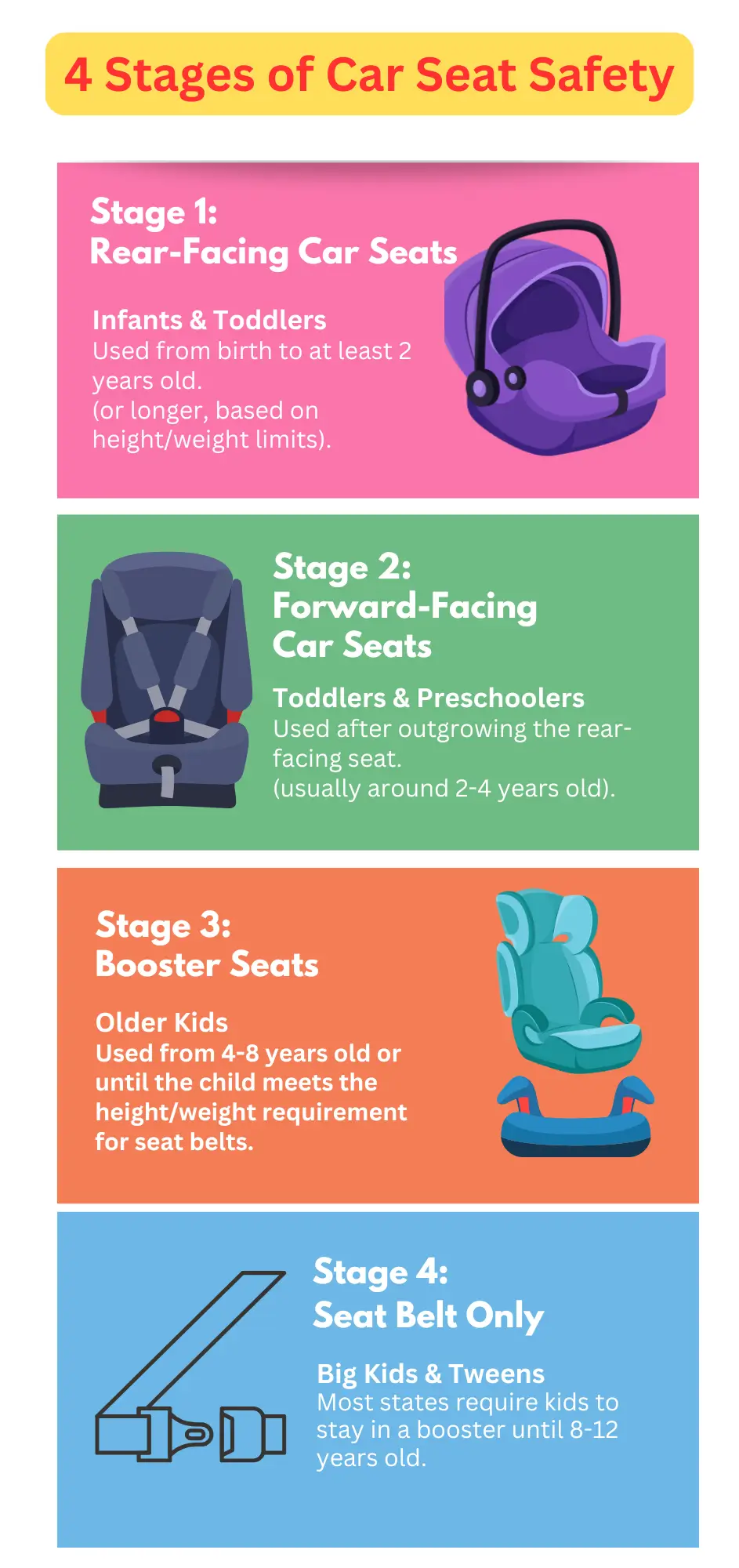

Illustrated chart showing the 4 stages of child car seat safety
4 stages of car seat safety: Visual guide


🧒 Stage 3: Booster Seats (Older Kids)

A booster seat is a child restraint system that elevates and positions a child so that the vehicle’s lap-and-shoulder belt fits him properly across the chest and lap.

It includes both high-back and backless booster seats, combination car seats, and all-in-one car seats.

👦 Stage 4: Seat Belt Only (Big Kids & Tweens)

When a child is old enough and can pass the five-step test, they are ready for the vehicle seat belt alone.
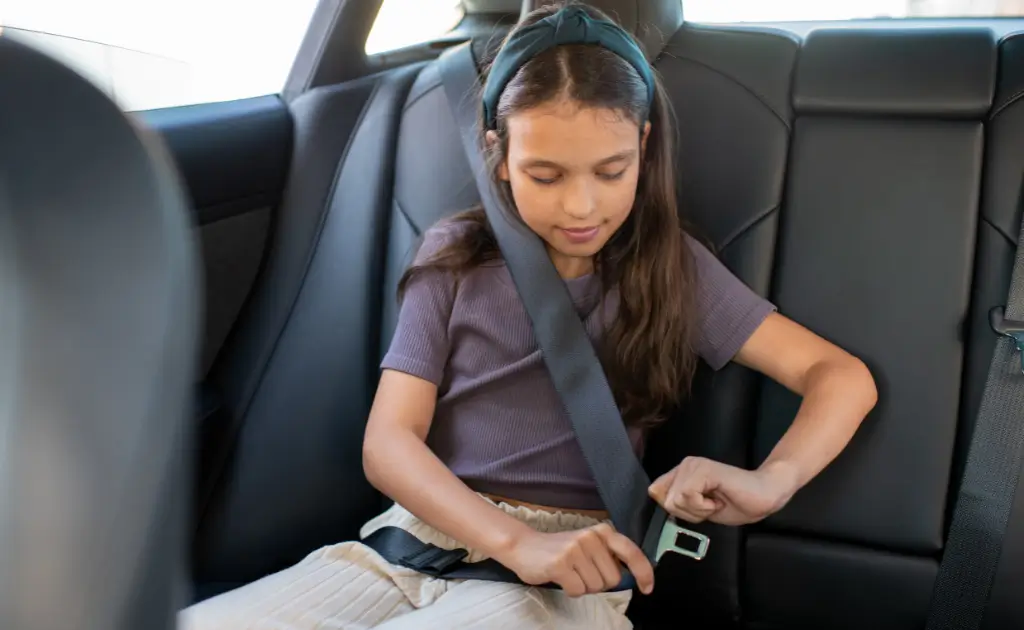
A young girl is going through 5 five-step test to get ready for a vehicle seat belt.

Five-Step Test

  • Will your child be able to sit like this the entire time?
  • Is your child leaning back against the chair?
  • Does your child’s knees slump or bend comfortably at the seat’s edge?
  • Is the belt positioned between the arm and the neck?
  • Is the lap belt positioned as close to the thighs as possible?

Penalties

Not following the law can result in fines and penalties. Some of them are as follows:

  • Fines range from $25 to over $500, depending on the state.
  • Some states add points to your driving record, which can raise your insurance rates.
  • Repeat offenders may face harsher penalties or perhaps legal action.

Caught Without a Car Seat?

Expect immediate fines, possible court-ordered safety courses, and, in serious cases, child endangerment charges. Some states allow you to fix the issue quickly to avoid penalties.

Repeat Offenders Face Harsher Consequences ⚖️

🚨 Multiple violations can lead to higher fines, suspended licenses, or legal action.

Common Car Seat Law Exceptions

In some cases, standard laws do not apply. Here are some exceptions:

🚕 Taxis & Rideshares: Some states don’t require car seats in Uber/Lyft, but using one is still safest.

🚗 Rental Cars: Most states still require car seats, so don’t assume you’re exempt!

🚑 Emergency Situations: In some cases (like a medical emergency), laws may allow exceptions.

Car Seat Laws for Air Travel: Can You Use a Car Seat on a Plane? ✈️

Many parents wonder: Is using a car seat on a plane required? The answer? No, but the Federal Aviation Administration (FAA) strongly recommends the use of baby car seats for children under 40 lbs. While airlines allow lap infants (kids under 2), the safest option is securing them in an FAA-approved car seat in their seat.

FAA-Approved Car Seats for Flights

Not all car seats are approved for air travel! All FAA-approved car seats will have a label stating: “This restraint is certified for use in motor vehicles and aircraft.” Most convertible and infant seats qualify, but boosters aren’t allowed without a harness mode.

Find out more details and travel tips for flying with Car Seats 👇

State-by-State Baby Car Seat Laws (2025 Updated Guide)

To help you easily navigate the latest car seat regulations, we’ve compiled a comprehensive table of state-by-state laws. Enter the name of your state in the search bar located at the top of the table to instantly access specific requirements—without the need to scroll through the full list.

StateRear-Facing SeatForward-Facing SeatBooster SeatCar seat belts onlyFine/PenaltiesSources
AlabamaUntil the child is at least one year of age or 20 pounds.Until the child is at least five years of age or 40 pounds.

Until the child is six years of age.until 15 years of age.$25Find More
AlaskaChildren less than one year of age or one year of age or older who weigh less than 20 poundsChildren one or more years of age but less than four years of age who weigh 20 pounds or moreChildren over four years of age but less than eight years of age who are less than 57 inches in height and weigh 20 or more pounds but less than 65 pounds over four years of age who is above 57inches in height and weighs more than 65$50Find More
ArizonaChildren younger than 8 years old and shorter than 4 feet, 9 inches, must be properly secured in a safety or booster seat.
Recommended:
less than 1 year or less than 20lbs
Children younger than 8 years old and shorter than 4 feet, 9 inches, must be properly secured in a safety or booster seat.
Recommended:
1-5 years old or 20-40lbs
Children younger than 8 years old and shorter than 4 feet, 9 inches, must be properly secured in a safety or booster seat.
Recommended:
5–8 yeas old and under 40lbs or under 57 inches
Above 8 and above 40 lbs or over 57"$50Find More
ArkansasChildren under 6 and <60 lbs are required to be restrained
Recommended:
Until 2 years
Children under 6 and <60 lbs are required to be restrained
Recommended:
2-5 years
Children under 6 and <60 lbs are required to be restrained
Recommended:
5-6 years
6-14 years or 60lbs or above 60lbs$100Find More
CaliforniaChildren under two years old to ride in a rear-facing car seat, unless the child weighs 40 or more pounds OR is 40 or more inches tall.Children under the age of 8 are required to be secured in a car or booster seat.
Recommended:
2-5 years
Children who are 8 years old or at least 57” may be secured by a booster seat
Recommended:
5-8 years

8 years or 57″ and above 57″
$500+Find More
ColoradoChildren under 2 years of age, and less than 40 pounds
Can continue to rear-face beyond 2 years of age and 40 pounds if child restraint allows it
Under 2 years of age, and over 40 pounds
2-4 years of age, and at least 20 pounds
Can continue to forward-face beyond 4 years of age and 40 pounds if child restraint allows it

4-9 years of age, and at least 40 pounds
Can continue to use a booster seat beyond 9 years of age
9-18 years of age$71Find More
ConnecticutUntil the children are a minimum of both 2 years and 30 pounds.Until 5 years and 40 poundsUntil they reach 8 years old and 60 pounds8-13 years and 60 lbs or over$199Find More
DelawareChildren under age 2 and 30 pounds to ride in a rear-facing car seatChildren under age 4 AND 40 pounds to ride in a harnessed car seatabove 4 years until reaching the height or weight maximum listed by the manufacturer8-12 years or above 65lbs$25 Find More
FloridaChildren through age 3 must be secured in a separate carrier or a vehicle manufacturer's integrated child safety seat.Children ages 4 and 5 must be in a car seat or booster seat.Children ages 4 and 5 must be in a car seat or booster seat.6 years and above until18 $60.00 and 3 points.Find More
GeorgiaAll children under the age of eight are required to be properly restrained in an appropriate child passenger safety seat or booster sea
Recommended
Until 2 years
All children under the age of eight are required to be properly restrained in an appropriate child passenger safety seat or booster seat
Recommended:
2-4 years
A lap belt can be used to restrain children weighing at least 40 pounds.
Recommended:
4-8 years
If your child reaches 4’9″ before age 8, your child can legally ride in an adult seat belt.$50Find More
HawaiiUntil 2 years2 years old but under 4 must be properly restrained in a rear-facing or forward-facing car seat with harness4 years old but under 10 must be in a child passenger safety seat or booster seat unless the child is over 4 feet 9 inches tall. Children 7-10 years old and taller than 4’9” must be properly restrained by a seat belt.$100+Find More
IdahoAll children 6 years of age or younger must be properly restrained in an appropriate child safety restraint.
Recommended:
Until 2 years
all children 6 years of age or younger must be properly restrained in an appropriate child safety restraint.
Recommended:
2-4 years and between 40-65 pounds
all children 6 years of age or younger must be properly restrained in an appropriate child safety restraint.
Recommended:
4-8 years and under 4’9”
7 years and above $84Find More
IllinoisChildren under the age of two are required to be secured in a rear-facing child restraint system unless they weigh more than 40 pounds or are at least 40 inches tall
Recommended:
Until 2 years
Children under the age of 8 years shall be secured in an appropriate child restraint system.
Recommended:
2-4 years
Children under the age of 8 years shall be secured in an appropriate child restraint system.
Recommended:
4-8 years
8-15 years and over 40 lbs in rear seat if only lap belt available$75Find More
IndianaAll children under the age of 8 must be properly restrained in a child safety seat or a booster seat according to the child restraint system manufacturer’s instructions.
Recommended:
Until 2 years
22lbs – 40 lbs
All children under the age of 8 must be properly restrained in a child safety seat or a booster seat according to the child restraint system manufacturer’s instructions.
Recommended:
2-4 years
between 40 to 65 pounds
Children a minimum age of 4 years and 40 pounds may use a booster seat, but parents are encourage to keep their children restrained in a forward-facing seat with a harness until at least 65 lbs.
Belt Positioning Booster Seats must be used with a lap and shoulder belt both.
8-16 years $25Find More
IowaChildren under 1 year of age and less than 20 pounds must be in an approved rear-facing child restraint system.All children under age 6 must be in a child restraint system – it must be an approved car seat.
Recommended:
1-6 years
All the children above 6 need to remain in a booster seat until they are 4’9”tall
Recommended:
6-11 years
All children 6 through 17 years and taller than 4’9” must be properly restrained by a seat belt.$195.Find More
KansasAll children under four are required to ride in a car seat.
Recommended:
Until 1 year
All children under four are required to ride in a car seat.
Recommended:
1-4 years
Children older than 4 but younger than 7 and who weigh less than 80 pounds or is less than 4’9″ are required to ride in a booster seat.Children older than 8 and younger than 12 who are more than 80 pounds or taller than 4’9″ must be protected by a seat belt.
Youth ages 14 through 17 must be protected by a seat belt.
$60Find More
KentuckyA child must be kept rear-facing to a minimum of one year of age and 20 pounds, with best practice being two years of age and
30 pounds.
Children less the 40 inches must be properly installed in a car seat.
Recommended:
1-4 years
Children younger than 8 years old and between 40 and 57 inches must be in a booster.
Recommended:
4-8 years
Children younger than 8 but taller than
57 inches can be restrained in the vehicle seat belt.
Children
$50Find More
LouisianaChildren under 2 years old must be in a rear-facing car seat until they reach the manufacturer’s height or weight limits for that seat. Children 2-4 years old must be in a forward-facing car seat with an internal harness until they outgrow it according to the manufacturer’s specifications.Children aged 4-9 years must use a belt-positioning booster seat once they have outgrown the forward-facing seat, secured with a vehicle lap-shoulder belt.9 - 17 years old children must use a standard vehicle safety belt that fits correctly, transitioning out of booster seats when they exceed the height and weight limits.
$100Find More
MaineChildren under 2 years of age shall properly be secured in a rear-facing child restraint system or convertible child restraint system properly secured in the rear-facing position in accordance to the manufacturer's and vehicle instructions. Children 2 years of age or older and weighing less than 55 pounds shall be secured in a child restraint system with an internal harness in accordance to the manufacturer’s and vehicle instructions.Children who weigh less than 80 pounds, are less than 57 inches in height and are less than 8 years of age are required to be properly secured in a belt positioning seat or other child restraint system in accordance to the manufacturer’s and vehicle instructions.8-17 years or under 18 years and over 57 inches tall$50-$250Find More
MarylandChildren must ride rear-facing until at least age two.Children under eight years old must ride in an appropriate child safety seat according to the vehicle and child restraint instructions, unless the child is 4’9” or taller.
Recommended:
2-4 years
Children under eight years old must ride in an appropriate child safety seat according to the vehicle and child restraint instructions, unless the child is 4’9” or taller.
Recommended:
4-8 years
8-15 yrs or under 8 yrs and over 57" tall$50Find More
MassachusettsAll children riding in passenger motor vehicles must be in a federally approved child passenger restraint that is properly fastened and secured according to the manufacturer's instructions until they are 8 years old or over 57 inches tall.
Recommended:
Until 2 years
All children riding in passenger motor vehicles must be in a federally approved child passenger restraint that is properly fastened and secured according to the manufacturer's instructions until they are 8 years old or over 57 inches tall.
Recommended:
2-5 years
All children riding in passenger motor vehicles must be in a federally approved child passenger restraint that is properly fastened and secured according to the manufacturer's instructions until they are 8 years old or over 57 inches tall.
Recommended:
5-8 years
Children older than 8 years of age or taller than 57 inches must wear a seat belt.$25Find More
MichiganA child must be in a rear-facing car seat until they reach the maximum weight or height allowed by the car seat’s manufacturer or the child is 2 years old.Children 2-5 years old must be secured in a forward-facing car seat until they reach the maximum weight or height allowed by the car seat’s manufacturer.Children 5-8 years old can be moved to a belt-positioning booster seat using a lap and shoulder belt until they are 4’ 9” or 8 years old.8-15 yrs and at least 4 feet 9 inches tall$65Find More
MinnesotaChildren under age 2 must be seated in a rear-facing seat with an internal harness until the child reaches the weight or height limit of the child passenger restraint system.Children who has outgrown their rear-facing car seat, and they are at least age two, they can ride in a forward-facing car seat with an internal 5-point harness until they are at least age 4 and have outgrown the seat by the height or weight limit, according to the car seat manufacturer.Children at least 4 years until 9 or exceeding the weight and height limit of the forward-facing child passenger restraint system must be properly restrained in a booster seat secured with a seat belt.Children at least 9 years of age or who have outgrown their booster seat AND they can pass the 5-Step Test. When a child can do ALL 5 steps, they are ready to ride with the lap and shoulder belt on the vehicle seat!$50Find More
MississippiChildren younger than 4 years must use a safety seat or similar restraint.
Recommended:
Until 2 years
Children younger than 4 years must use a safety seat or similar restraint.
Recommended:
2-4 years
Children 4 through 6 years old must use a booster seat if they are shorter than 57 inches (4 feet, 9 inches) tall, or if they weigh less than 65 pounds.Adult safety belts may be used without a booster when the child reaches 7 years of age, or is at least 57 inches tall, or weighs at least 65 pounds.$25Find More
MissouriChildren less than four years old OR less than 40 pounds
must be in an appropriate
child safety seat.
Recommended:
Until 1 year
Children less than four years
old OR less than 40 pounds
must be in an appropriate
child safety seat.
Recommended:
1-4 years
Children ages 4 through 7 who weigh at least
40 pounds must be in an
appropriate child safety seat
OR booster seat UNLESS they
are 80 pounds OR 4’9” tall.
Children eight and over OR
weighing at least 80 pounds
OR at least 4’9” tall are
required to be secured by a
safety belt OR booster seat
appropriate for that child.
$50Find More
MontanaEach motor vehicle passenger who is under 6 years of age and weighs less than 60 pounds must be transported and properly restrained in a child safety restraint. The child safety restraint must be appropriate for the height and weight of the child as indicated by manufacturer standards.
Recommended:
Until 2 years
Each motor vehicle passenger who is under 6 years of age and weighs less than 60 pounds must be transported and properly restrained in a child safety restraint. The child safety restraint must be appropriate for the height and weight of the child as indicated by manufacturer standards.
Recommended:
2-4 years
Each motor vehicle passenger who is under 6 years of age and weighs less than 60 pounds must be transported and properly restrained in a child safety restraint. The child safety restraint must be appropriate for the height and weight of the child as indicated by manufacturer standards.
Recommended:
4-6 years
Children 6 yrs and older and over 60 lbs $100Find More
NebraskaAll children to be in rear-facing safety seats until age 2 or until they reach the upper weight and height limits allowed by the car seat manufacturer.All children at least 2 years old and has outgrown the rear-facing seat with internal harness by height and weight must be secured in forward-facing seats with internal harness.
All children 4 years old and has outgrown a forward-facing seat by height and weight must ride in a belt positioning booster seat using lap belt and shoulder belt.

Children age 9-13 who are riding can be secured by seat belts.$25Find More
NevadaChildren under 2 years old must ride
in a rear-facing safety seat in the back seat of the
vehicle.
Any child less than 6 years of age who is less than
57 inches tall must ride in an approved child restraint system.
Recommended:
2-3 years
Any child less than 6 years of age who is less than
57 inches tall must ride in an approved child restraint system.
Recommended:
4-7 years
6 yrs and older and 57 inches or taller
Recommended:
8-12 years
$100 to $500,Find More
New HampshireChildren less than 2 years of age are required to be properly fastened and secured by a rear facing child restraint system which is in accordance with safety standards.Children under 7 or under 57 inches shall be properly fastened and secured by a federally-approved child restraint system approved by the United States Department of Transportation.
Recommended:
2-6 years
Children under 7 or under 57 inches shall be properly fastened and secured by a federally-approved child restraint system approved by the United States Department of Transportation.
Recommended:
6-7 years
Children 57 inches or more in height.
Recommended:
7-17 years
$50 to $100Find More
New JerseyA child under age 2 and under 30 lbs. must be in a rear-facing car seat with a five-point harness.A child under age 4 and 40 lbs. must remain in either a rear-facing or a forward-facing car seat with a five-point harness in the back seat of a vehicle.
Recommended:
2-4 years
Children must remain in a car seat or a booster seat in the back seat of a vehicle until they are at least 8 years old or 57 inches tall.
Recommended:
4-8 years
A child age 8 and older or over 57" can sit in a regular seat using a seat belt.$50 to $75Find More
New MexicoChildren under the age of 1 must ride in a rear-facing child safety seat in a back seat.Children 1 to 5 years of age or children who weigh less than 40 pounds (regardless of age) shall be properly secured in a federally approved child safety seat.
Children between the ages of 5 and 6 or children who are under 60 pounds (regardless of age) must ride in a child safety seat or booster seat.Children between 7 and 12 years old must be properly restrained in a child safety seat or booster seat until the adult seat belt fits them properly.
Teenagers between 13-17 years old must ride in a seat belt.

$25Find More
New YorkAll children under the age of 2 must ride in a rear-facing car seat.Children under four years of age and 40 pounds need to be in a car seat, which can be forward-facing.
Recommended:
2-4 years
Children under eight years of age, weighing more than 40 lbs and under 100 lbs, and shorter than 4’9” must be properly secured in an appropriate child restraint system(child safety seat or harness/vest or booster seat).
Recommended:
4-8 years
When a child reaches the height of 4’9,” a regular seat belt can properly and safely secure them.
Recommended:
8-12 years
$25 to $100Find More
North CarolinaChildren less than age 5 and less than 40 pounds
must be in the rear seat if the vehicle has an active
passenger-side front air bag and a rear seat.
Children younger than age 8 and who weigh less than 80 pounds must be properly secured in a child
restraint or booster seat.
Recommended:
2-5 years
Children younger than age 8 and who weigh less than 80 pounds must be properly secured in a child
restraint or booster seat.
Recommended:
5-8 years
When a child reaches age 8 or 80 pounds, a properly fitted seat belt can be used in place of a car seat or booster seat.
Booster seats must not be used with just a lap belt, so lap-only seat belts can be used for children over 40
pounds if no lap and shoulder seat belt is available.
$25 fine and at least $120 court costsFind More
North DakotaChildren younger than 7 are required to ride in a child restraint (car seat or
booster seat). The restraint must be used correctly – following the manufacturer’s
instructions.
Recommended:
Until 2 years
Children younger than 7 are required to ride in a child restraint (car seat or
booster seat). The restraint must be used correctly – following the manufacturer’s
instructions.
Recommended:
2-4 years
Children younger than 7 are required to ride in a child restraint (car seat or
booster seat). The restraint must be used correctly – following the manufacturer’s
instructions.
Recommended:
4-7 years
Children ages 7 through 17 must be properly secured in a seat belt or child restraint.(car seat or booster seat).
A seat belt may be substituted for children younger than 7 who weigh more than 80
pounds and are more than 57 (4’9”) inches tall.
$25Find More
OhioChildren less than 4 years old or 40 pounds must use a child safety seat meeting federal motor vehicle safety standards.
Recommended:
Until 2 years
Children less than 4 years old or 40 pounds must use a child safety seat meeting federal motor vehicle safety standards.
Recommended:
2-4 years
Children less than 8 years old, unless they are at least 4 feet, 9 inches tall must use a booster seat.
Recommended:
4-8 years
Children ages 8-15 must use a child safety seat or safety belt.$75Find More
OklahomaAll children under age 2 must be properly secured in a rear-facing car seat.
All children under age 4 must be properly secured in a car
seat with an internal harness.
Recommended:
2-4 years
All children at least 4 years old (but younger than age 8) must ride in a child passenger
restraint system or booster
seat, unless they are taller than 4’9”..
Recommended:
4-8 years
All children taller than 4’9”
(or age 8 and up) should be
restrained in a seat belt.
$50Find More
OregonInfants must ride rear-facing until they reach two years of age .Children must be restrained in child safety seats until they weigh forty pounds or reach the upper weight limit for the car seat in use.
Recommended:
2-5 years
Children over forty pounds or who have reached the upper weight limit for their forward-facing car seat must use a child seat with harness or a booster to 4'9" tall or age eight and the adult belt fits correctly.
Recommended:
5-8 years
Children who are taller than 4’9″ or 8 years of age must be properly secured with a safety belt or safety harness.$115Find More
PennsylvaniaChildren from birth to 2 years age must be secured in a rear-facing car seat until they outgrow the maximum weight and height limits designated by the car seat manufacturer.Children rom birth to 4 years age must be properly restrained in an approved child safety seat anywhere in the vehicle.
Recommended:
2-4 years
Children from 4-8 years must be restrained in an appropriate booster seat.8 years and older children must be in a seat belt.
Recommended:
8-12 years
$75Find More
Rhode IslandAll children under the age of 2 years or weighing less than 30 lbs shall be restrained in a rear-facing car seatAll children 2 years of age or older or who have outgrown their rear-facing car seat by height or weight should use a forward-facing car seat with a harness up to the maximum allowed by the child restraint manufacturer.
Recommended;
2-4 years
Children under the age of eight (8), less than fifty-seven (57) inches in height and less than eighty (80) pounds shall be properly restrained in a child restraint system approved by the United States Department of Transportation
Recommended:
4-8 years
If the child is under 8 years old but at least 57″ in height, or at least 80 lbs, the child shall be properly wearing a safety belt and/or shoulder harness approved by the Department of Transportation.
Children more than 8 years but under 18 years of age in any seating position within a motor vehicle shall be properly wearing a safety belt and/or shoulder harness system.
$85; $40 for children between 8-17
Find More
South CarolinaChildren under age 2 must use a rear-facing car seat in the rear passenger seat of a vehicle until their height or weight exceeds the manufacturer’s recommended limit for each.Children aged 2 through age 4 must use a forward-facing car seat with a harness until they outgrow it.Children ages 4-8 who outgrow the forward-facing car seat must use a booster seat with lap and shoulder belts in a vehicle’s rear passenger seat.Children aged 8 or those reaching 57 inches tall can use an adult seat belt.$150Find More
South DakotaChildren under 5 years of age and
under 40 pounds are required to use an
approved child safety seat in all seating
positions.
Recommended:
Until 2 years
Children under 5 years of age and
under 40 pounds are required to use an
approved child safety seat in all seating
positions. T
Recommended:
2-5 years
Children under 5 years of age and
under 40 pounds are required to use an
approved child safety seat in all seating
positions. T

Recommended:
5-7 years
The requirements of this law are met if the child is under 5 years of age and is at least 40 pounds in weight by securing the child in a seat belt (but it is not a good practice).
Children between the ages of 5 and 17 must wear a properly adjusted and fastened safety seat belt system, required to be installed in the passenger vehicle.

$25Find More
TennesseeChildren under 1 year of age, or any child, weighing 20 pounds or less, must be secured in a child passenger restraint system in a rear facing position, meeting federal motor vehicle safety standards, in a rear seat, if available, or according to the child safety restraint system or vehicle manufacturer's instructions.Children age 1 through age 3, and weighing more than 20 pounds, must be secured in a child safety seat in a forward facing position in the rear seat, if available, or according to the child safety restraint system or vehicle manufacturer's instructions.Children age 4 through age 8, and measuring less than 4'9" in height, must be secured in a belt-positioning booster seat system, meeting federal motor vehicle safety standards in the rear seat, if available, or according to the child safety restraint system or vehicle manufacturer's instructions.Children age 9 through age 12, or any child through 12 years of age, measuring 4'9"or more in height, must be secured in a seat belt system.
Children age 13 through age 15 must be secured by using a passenger restraint system, including safety belts, meeting federal motor vehicle safety standards.
$50Find More
TexasAll children younger than eight years old, unless they are taller than 4 feet 9 inches, be secured in a child safety seat whenever they ride in a vehicle
Recommended:
Until 2 years
All children younger than eight years old, unless they are taller than 4 feet 9 inches, be secured in a child safety seat whenever they ride in a vehicle
Recommended:
2-4 years
All children younger than eight years old, unless they are taller than 4 feet 9 inches, be secured in a child safety seat whenever they ride in a vehicle.
Recommended:
4-8 years
Older children who have outgrown a booster or 8 yrs or older or over 57"
must be buckled with a seat belt.
$250Find More
UtahChildren under eight years old must travel in a child restraint device appropriate to their age, height, and weight.
Recommended:
Until at least age 2 and 30 pounds
Children under eight years old must travel in a child restraint device appropriate to their age, height, and weight.
Recommended:
Until at least age 4, about 40 pounds or more
Children under eight years old must travel in a child restraint device appropriate to their age, height, and weight.
Recommended:
4-8 years until at least 4'9"
Children ages 8 to 16 are required to wear a seat belt.
Children younger than 8 can use the regular lap and shoulder belt without a booster if they are at least 57 inches tall.
$45Find More
VermontChildren under age 2 must be
properly secured in a
federally approved
rear-facing child car
seat with a harness.
A child in a rear-facing car seat must
not ride in front of an
active airbag.
Recommended:
Birth to 2

Children over age
2, but under age
5, must be
properly secured in
a federally approved
rear-facing or
forward-facing car
seat with a harness.
Recommended:
2 to 5
Children under age
8 who are not
properly secured in
a harnessed car seat
must be properly
secured in a booster
seat.
Recommended
5-8 years
Children under age
18 who are not
properly secured in
a harnessed car
seat or booster seat
must be wearing a
seat belt.
Recommended:
8 to 18 years
Up to $100Find More
VirginiaChildren are required to ride in a rear-facing safety seat in the back seat of a vehicle until the age of two or they reach the minimum weight limit of their forward-facing safety seat.
Restraint devices are required for children through the age of seven (until 8th birthday).
Use a forward-facing safety seat with a five-point harness after the child has outgrown the rear-facing safety seat’s weight or height limits.
Recommended:
2-5 years
Use a booster seat once children outgrow their forward-facing safety seat by height or weight.
Continue using a booster seat until the child can fit the vehicle seat belt.
Recommended:
5-8 years
Children 8 to18 years old must be restrained using a vehicle seat belt.$50 to $500Find More
WashingtonChildren up to age 2 must ride in a rear-facing car seat.
Children ages 2 to 4 must ride in a car seat with a harness (rear or forward-facing).
Children 4 years and older must ride in a car or booster seat until they are 4’9’’ in height. Recommended:
4-8 years
Children over height 4’9” must be secured by a properly fitted seat belt (typically starting at 8-12 years old).$124Find More
West VirginiaChildren under the age of 8 and under 4 feet and 9 inches tall must be properly secured in a federally approved child safety seat or booster seat.
Recommended:
Until 2 years
Children under the age of 8 and under 4 feet and 9 inches tall must be properly secured in a federally approved child safety seat or booster seat.
Recommended:
2-4 years
Children under the age of 8 and under 4 feet and 9 inches tall must be properly secured in a federally approved child safety seat or booster seat.
Recommended:
4-8 years
Children aged eight or older, or children who reach 4’9” before turning eight, may be secured by a car’s safety belt rather than by a booster seat or car seat.

$10-$20Find More
WisconsinChildren less than 1 year old, or less than 20 lbs. must be in a rear-facing child seat in the back seat (if so equipped).If a child is at least one year old and 20 pounds, but less than four years old or less than 40 pounds, must be in a forward- or rear-facing child seat in the back seat (if so equipped).Children age 4 to 8, and between 40-80 lbs., and no more than 4 ft. 9 in. must be in a forward- or rear-facing child seat in the back seat (if so equipped) or a booster seatChildren who reach age 8, more than 80 pounds in weight, or more than 4 ft. 9 in. tall can be secured by a car seat belt only.If less than four years of age, the total penalty is $175.30.
If between ages 4 and 8, the total penalty is $150.10 for the first offense, $200.50 for a second offense, and $263.50 for third and subsequent offenses

Find More
WyomingEach child under 9 years old to be properly secured in a child safety restraint system.
The car seat system must be installed in the rear seat if available and a rear-facing seat cannot be installed in front of an active airbag.
Recommended:
Until 2 years
Each child under 9 years old to be properly secured in a child safety restraint system installed in the rear seat.
Recommended:
2-4 years
Each child under 9 years old to be properly secured in a child safety restraint system installed in the rear seat.
Recommended:
4-9 years
9 yrs or older$50 to $100Find More

Note:

🔹 Each state has slightly different laws, so always check the official state DMV or law enforcement websites for updates.
🔹 Fine amounts vary based on court fees & violations—this table provides a general guide.

Free Car Seat Inspections

Fire stations, police departments, and hospitals offer free car seat checks. Find a certified inspection site at nhtsa.gov.

Frequently Asked Questions

  • Most booster seats are designed for kids between 40–100 lbs and 38–57 inches tall. However, always check the seat's manual and your state law, as both may vary slightly.
  • In most states, kids can sit in the front seat at age 13. It's always safest to keep them in the back seat as long as possible—especially with airbags in the front.
  • States have different laws governing ridesharing and taxis. Parents must bring their car seats in some states, while others exempt ridesharing and taxis from car seat regulations. It is advisable to review the relevant laws in your state prior to the ride.
  • Reusing a car seat is okay only if it hasn't expired, been recalled, or involved in a crash. Always inspect it thoroughly and make sure it still meets safety standards.
  • Car seats that have expired may not offer adequate protection and are regarded as dangerous. Manufacturers set expiration dates (usually 6–10 years after manufacture) due to wear and evolving safety standards. It's best to replace them when they expire.

Summary

Baby car seat laws in the United States may appear confusing, but they are not. You may easily understand and abide by the rules of your state if you are familiar with the fundamentals and a few key terms. Keep checking back since these laws are subject to change. Additionally, feel free to ask questions in the comments if you have any questions. All of us are traveling this parenting journey together.